
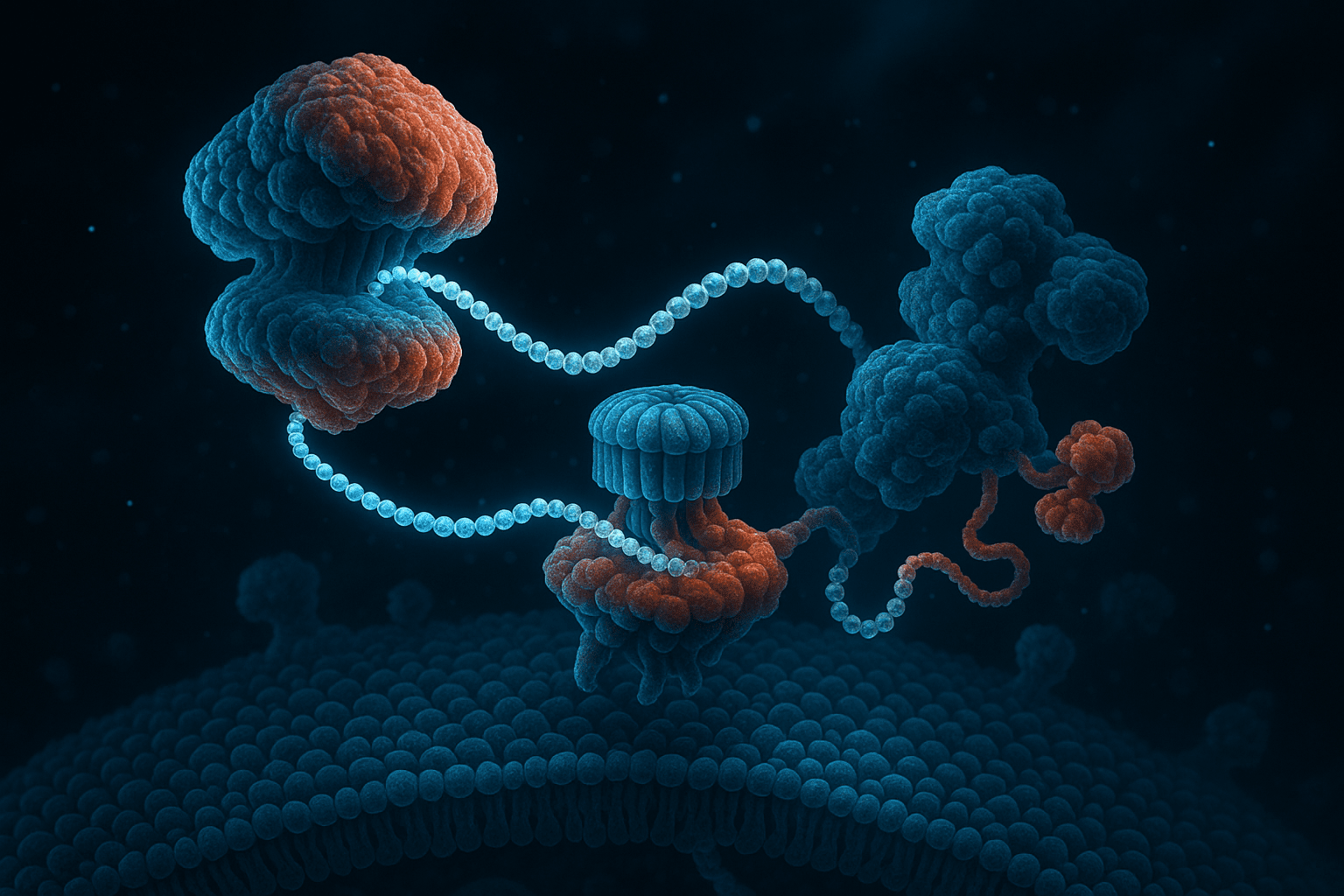
(Series: Beyond Matter: Seven Proofs for God – Post 4)
🧠 You Are More Than Meat
When you look into a mirror, you see skin, bone, and the organ we call the brain, well kinda lol. But what you experience is something far more mysterious: an inner world of thoughts, emotions, memories, and awareness.
This is consciousness — the fact that we are not merely reacting machines, but aware beings. We don’t just process input and output like a computer. We experience life. We make choices. We reflect on ourselves.
Atheism and strict materialism insist that human beings are nothing more than complex biological machines, with consciousness being nothing but neurons firing in the brain. Yet this explanation quickly unravels. How do blind physical processes, with no awareness themselves, suddenly produce subjective awareness? How do atoms, bouncing according to physical laws, generate thoughts about morality, art, or God?
The very existence of consciousness is a direct challenge to the materialist worldview.
What is even worst and more damning to the human condition is the strict materialist view that if we are just evolution of chemicals then free will doesn’t really exist. We’re all just groups of collective cells and chemistry interacting with each other and the world we see, us going to work, the conversations are not actually real. We are not actually choosing to do those things but we are just chemical beings following an evolutionary process and these are all just chemical actions and reactions. I’ll just leave that there for you to ponder on.
👀 The Hard Problem of Consciousness
Neuroscience has given us incredible insights into how the brain works. We know which areas light up when we feel fear, love, or joy. We can even alter moods with chemicals or electrical stimulation. But this still doesn’t explain consciousness itself.
Philosopher David Chalmers famously called this the “hard problem of consciousness.” He explains:
“The really hard problem of consciousness is the problem of experience. When we think and perceive, there is a whir of information-processing, but there is also a subjective aspect. Why should physical processing give rise to a rich inner life at all?”
This is a profound point. A computer can process data, but it doesn’t know it is doing so. It has no inner experience. Yet humans do. You don’t just register information — you are aware of being aware.
This awareness, this first-person perspective, has no place in a purely physical worldview. If reality is only atoms in motion, there should be no “inner movie” of experience. And yet here we are, undeniably conscious. We can speak to ourselves in our own mind and contemplate information separate from any physical interaction. This would get into the distinctions the Bible makes between Body, Mind and Spirit. That’s for another blog post though, this post is just about a belief in a God as a truth and not necessarily the God of the Bible. I’m not making a plea for your heart in this series but an appeal to your mind to be opened.

⚖️ The Failure of Reductionism
Materialists attempt to reduce consciousness to nothing more than brain activity. “The mind,” they say, “is what the brain does.” But this explanation collapses under scrutiny.
- Thoughts have truth value. They can be true or false. But neurons firing are not “true” or “false” — they just follow chemical and electrical patterns. A logical syllogism (“All men are mortal; Socrates is a man; therefore, Socrates is mortal”) cannot be reduced to molecules. Logic is not chemistry.
- Reason is not physical. If our thoughts are entirely determined by prior physical causes — atoms colliding according to blind laws — then we don’t actually reason. We just undergo brain events. The belief in materialism itself would be the result of blind processes, not rational reflection.
- Free will becomes an illusion. Under strict materialism, every choice we make is predetermined by the prior state of matter. That means you didn’t “choose” to read this sentence — atoms in your brain simply arranged themselves to create the illusion of choice.
Even atheists have recognized this contradiction. Biologist and philosopher J.B.S. Haldane admitted:
“If my mental processes are determined wholly by the motions of atoms in my brain, I have no reason to suppose that my beliefs are true. They may be sound chemically, but that does not make them sound logically. And hence I have no reason for supposing my brain to be composed of atoms.”
This is the fatal flaw: if materialism is true, then reason itself collapses. The very act of trusting our own thoughts assumes that we are more than matter.
🔍 Consciousness Points Beyond Matter
Consciousness is not a problem for theism — it’s exactly what we would expect if reality is grounded in a conscious Mind. Our finite awareness would then be a reflection of the infinite Consciousness that created us.
C.S. Lewis exposed this issue powerfully:
“If minds are wholly dependent on brains, and brains on biochemistry, and biochemistry (in the long run) on the meaningless flux of atoms, I cannot understand how the thought of those minds should have any more significance than the sound of the wind in the trees.”
In other words, if materialism is true, our thoughts are no more meaningful than rustling leaves. But if God is real, then consciousness is not a fluke — it is a gift, a signature of our Creator. It makes perfect sense that you have the freedom to oppose God—you were given the will to choose. You can look at the evidence and decide for yourself to say “no.” That decision is not just the byproduct of chemical reactions firing in your brain; it’s a conscious act of thought and will. Even if we disagree about God, your thoughts, your feelings, and your wellbeing still matter to me—and that matters because it’s real. I genuinely wish you success, peace, health, and happiness. Those desires come from my conscious mind, not from random molecules colliding. Neither of us is a mindless machine—we are living souls capable of love, choice, and meaning. The difference is my worldview allows for this to be real and yours does not, if you follow a strictly atheistic and materialist worldview.

🧬 Neuroscience and the Soul
Brain science shows correlation, but not identity. Yes, damage to the brain affects consciousness. But correlation does not prove that consciousness is caused entirely by the brain.
Consider a radio. If the circuits are damaged, the signal will be distorted or lost. But the signal itself is not produced by the radio — it comes from outside. Similarly, the brain may be the instrument, but the “signal” of consciousness comes from beyond mere matter.
Neuroscientist Mario Beauregard writes:
“Consciousness cannot be reduced to neural activity inside the brain. The mind is not simply the brain, and human beings cannot be fully understood as material beings alone.”
Further evidence comes from near-death experiences, where patients report vivid consciousness at times when their brain activity has flatlined. This suggests that the mind is not entirely dependent on the brain, but may transcend it.
⚔️ The Atheist Retreat
When faced with the mystery of consciousness, atheists often respond with a shrug: “Science will figure it out someday.”
But this is not an explanation — it is a confession of ignorance disguised as confidence. Consciousness has remained unexplained despite decades of neuroscience progress. In fact, the more we learn about the brain, the clearer it becomes that awareness itself does not fit into the materialist framework.
Atheist philosopher Thomas Nagel, though not a Christian, openly acknowledged this problem:
“Consciousness is the most conspicuous obstacle to a comprehensive naturalism that relies only on the physical sciences. If the mental is not itself merely physical, it cannot be fully explained by science.”
Nagel went so far as to argue that the existence of consciousness makes atheism and materialism untenable.
✨ Why God Explains It Best
Consciousness finds its best explanation not in atoms, but in God. If reality begins not with dead matter but with a living Mind, then consciousness is not a mystery at all. It is expected.
- Our ability to reason reflects the rationality of the Creator.
- Our free will reflects the personal nature of God.
- Our awareness of truth points us back to the ultimate Truth.
Atheism leaves us with a contradiction: it denies the very rationality it must use to argue against God. Theism, by contrast, makes sense of consciousness as a reflection of the divine image in humanity.
🔮 Where Do We Go Next?
We’ve seen that the mind cannot be reduced to matter, and that consciousness itself points beyond the material to an ultimate Mind. But consciousness is not the only signpost within us. There is another dimension of human experience that resists materialist explanation: our sense of morality.
Why do we feel the weight of right and wrong as if it were something objective, binding, and universal?
That’s where we’ll go in Post 5: The Moral Argument.
If reality points beyond matter, don’t stop at the surface. Subscribe to The Witness Report for weekly articles that connect logic, Scripture, and discovery — exploring what it really means to know the Creator through reason and revelation.



Leave a Reply